Business
How to Generate Sales Leads: A Step-by-Step System
How to Generate Sales Leads: A Step-by-Step System
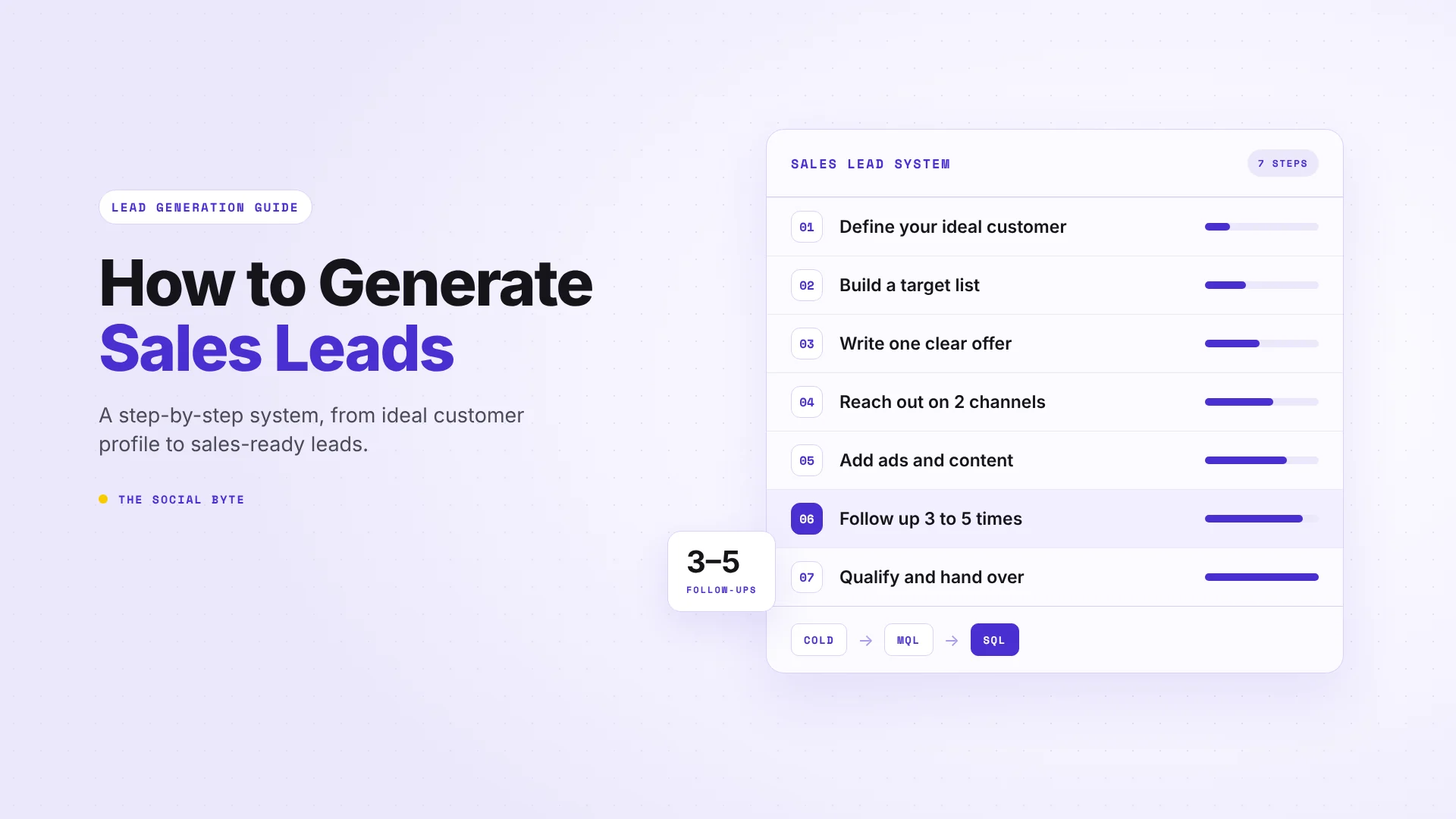
Define your ideal customer, build a target list, reach out on two channels, back it with ads and content, follow up 3 to 5 times and track every lead in a CRM. Here is the step-by-step system.
Define your ideal customer, build a target list, reach out on two channels, back it with ads and content, follow up 3 to 5 times and track every lead in a CRM. Here is the step-by-step system.
Most businesses don't have a lead problem. They have a consistency problem. A few referrals arrive, sales gets busy, outreach stops, and the pipeline dries up a month later.
This guide gives you a simple, repeatable system for generating sales leads. It works for agencies, service businesses and B2B companies, and it is the same process our lead generation team uses for clients in the US, Canada and Pakistan.
What is a sales lead?
A sales lead is a person or company that could buy from you and that you can contact. A lead becomes useful when you know two things: that they fit your ideal customer, and that they have shown some interest.
Cold lead: fits your target market, no contact yet. Example: a dental clinic owner found on LinkedIn.
Marketing qualified lead (MQL): engaged with your marketing. Example: downloaded a guide or joined a webinar.
Sales qualified lead (SQL): has a need, budget and timeline. Example: booked a call and asked for pricing.
The system below moves people from cold to SQL, step by step.
How to generate sales leads in 7 steps
Here is the full system at a glance, followed by each step in detail.

1. Define your ideal customer profile
Write down who buys from you most easily and pays the most. Include industry, company size, location, the decision maker's job title and the problem you solve for them. If you sell to everyone, your outreach speaks to no one.
2. Build a target list
Use LinkedIn Sales Navigator, Google Maps, industry directories and your own past clients to find matching companies. Verify emails before you send. Start with 200 to 500 contacts so you can test messages before you scale.
3. Write one clear offer
People reply to a specific result, not a list of services. Offer something small and useful: a free website audit, a sample design, a competitor report or a 15-minute strategy call.
4. Reach out on at least two channels
Pair email with LinkedIn or phone. Keep the first message under 100 words: who you are, the problem you noticed and one question. Personalise the first line for each contact.
5. Back it up with ads and content
Outbound works better when people have already seen your name. Run retargeting ads to your list and website visitors, and publish posts that answer your buyers' questions. These also bring inbound leads you did not have to chase.
6. Follow up 3 to 5 times
Most replies come after the first email. In a 2025 study of 7.5 million B2B emails by Belkins, follow-ups produced 58.6% of all replies, and the third step alone drove 35.6% of meetings booked from email. Replies fell sharply after the fifth step, so 3 to 5 follow-ups is the sweet spot.
A simple cadence:
Day 1: first email
Day 3: LinkedIn connection request
Day 5: follow-up 1 with a useful example
Day 9: follow-up 2 with a short case result
Day 14: follow-up 3, a short final check-in
7. Qualify and hand over to sales
Before a lead goes to sales, confirm three things: a real need, a budget and a timeline. Log every lead and every touch in a CRM such as HubSpot or Pipedrive, so nothing slips through and you can see which channel works.
Which lead generation channels work best?
The best channel is the one where your buyers already spend time. Most businesses get the best results by combining one outbound and one inbound channel.

Start with the fastest channel to fill this month's pipeline, and build content and SEO alongside it so future leads cost less.
What to track: lead generation metrics
Track four numbers every week. They tell you whether the problem is volume, quality or follow-up.
Reply rate (replies divided by contacts reached): is the message and list right?
Meetings booked (calls booked per week): is the offer strong enough?
Cost per lead (total spend divided by leads): which channel should you scale?
Lead-to-customer rate (customers divided by leads): is lead quality good?
Benchmarks vary a lot by industry and deal size. B2B funnel roundups commonly put lead-to-customer conversion at around 2% to 5% (Prospeo, 2026). Compare yourself against your own numbers month to month first. That trend matters more than any industry average.
Common mistakes that kill sales leads
Targeting everyone. A vague audience means generic messages and low replies.
Stopping after one email. Follow-ups bring most of the meetings, so a single send wastes the list.
Leading with your services. Buyers care about their problem, not your menu.
Slow responses to inbound leads. Reply the same day, ideally within the hour, while interest is high.
No CRM. Leads kept in inboxes and spreadsheets get forgotten.
Never testing. Change one thing at a time (subject line, offer, channel) and keep what works.
Quick checklist
Ideal customer profile written down
200 to 500 verified contacts in a CRM
One clear, result-based offer
Outreach running on two channels
Retargeting ads and weekly content live
3 to 5 follow-ups scheduled for every contact
Need, budget and timeline checked before handover
Start building your sales pipeline
Generating sales leads is not about one big campaign. It is a weekly habit: the right list, a clear offer, two channels, steady follow-up and honest tracking. Set it up once, review it every week, and your pipeline stops depending on luck.
Want a team to run this system for you? The Social Byte builds targeted lead lists, runs outreach and ads, and hands you qualified sales leads. Book a free marketing audit to see where your next leads will come from.
Frequently Asked Questions
How do I generate sales leads consistently?
Run lead generation as a weekly system: a fixed number of new contacts each week, outreach on two channels, 3 to 5 follow-ups, and a weekly review of replies and meetings in your CRM.
How many sales leads do I need per month?
Work backwards from your goal. If you want 4 new clients a month and 1 in 10 qualified leads becomes a client, you need about 40 qualified leads. Then use your own reply and meeting rates to set how many contacts to reach.
What is a good lead-to-sale conversion rate?
It depends on industry and deal size. B2B benchmark roundups often cite around 2% to 5% from lead to customer. Qualified leads convert much higher, so improving lead quality matters more than raw volume.
How many follow-ups does it take to close a lead?
Plan for 3 to 5 follow-ups. Large outreach studies show most replies and meetings come after the first message, and returns drop after the fifth step.
How do I build a list of sales prospects?
Start from your ideal customer profile, then find matching contacts on LinkedIn Sales Navigator, Google Maps and industry directories. Verify every email and add the list to a CRM before outreach.
Stay Inspired
Get fresh design insights, articles, and resources delivered straight to your inbox.
Latest Blogs


Stay Inspired
Get fresh design insights, articles, and resources delivered straight to your inbox.

Business
How to Generate Sales Leads: A Step-by-Step System
How to Generate Sales Leads: A Step-by-Step System
Define your ideal customer, build a target list, reach out on two channels, back it with ads and content, follow up 3 to 5 times and track every lead in a CRM. Here is the step-by-step system.
Define your ideal customer, build a target list, reach out on two channels, back it with ads and content, follow up 3 to 5 times and track every lead in a CRM. Here is the step-by-step system.
Most businesses don't have a lead problem. They have a consistency problem. A few referrals arrive, sales gets busy, outreach stops, and the pipeline dries up a month later.
This guide gives you a simple, repeatable system for generating sales leads. It works for agencies, service businesses and B2B companies, and it is the same process our lead generation team uses for clients in the US, Canada and Pakistan.
What is a sales lead?
A sales lead is a person or company that could buy from you and that you can contact. A lead becomes useful when you know two things: that they fit your ideal customer, and that they have shown some interest.
Cold lead: fits your target market, no contact yet. Example: a dental clinic owner found on LinkedIn.
Marketing qualified lead (MQL): engaged with your marketing. Example: downloaded a guide or joined a webinar.
Sales qualified lead (SQL): has a need, budget and timeline. Example: booked a call and asked for pricing.
The system below moves people from cold to SQL, step by step.
How to generate sales leads in 7 steps
Here is the full system at a glance, followed by each step in detail.
1. Define your ideal customer profile
Write down who buys from you most easily and pays the most. Include industry, company size, location, the decision maker's job title and the problem you solve for them. If you sell to everyone, your outreach speaks to no one.
2. Build a target list
Use LinkedIn Sales Navigator, Google Maps, industry directories and your own past clients to find matching companies. Verify emails before you send. Start with 200 to 500 contacts so you can test messages before you scale.
3. Write one clear offer
People reply to a specific result, not a list of services. Offer something small and useful: a free website audit, a sample design, a competitor report or a 15-minute strategy call.
4. Reach out on at least two channels
Pair email with LinkedIn or phone. Keep the first message under 100 words: who you are, the problem you noticed and one question. Personalise the first line for each contact.
5. Back it up with ads and content
Outbound works better when people have already seen your name. Run retargeting ads to your list and website visitors, and publish posts that answer your buyers' questions. These also bring inbound leads you did not have to chase.
6. Follow up 3 to 5 times
Most replies come after the first email. In a 2025 study of 7.5 million B2B emails by Belkins, follow-ups produced 58.6% of all replies, and the third step alone drove 35.6% of meetings booked from email. Replies fell sharply after the fifth step, so 3 to 5 follow-ups is the sweet spot.
A simple cadence:
Day 1: first email
Day 3: LinkedIn connection request
Day 5: follow-up 1 with a useful example
Day 9: follow-up 2 with a short case result
Day 14: follow-up 3, a short final check-in
7. Qualify and hand over to sales
Before a lead goes to sales, confirm three things: a real need, a budget and a timeline. Log every lead and every touch in a CRM such as HubSpot or Pipedrive, so nothing slips through and you can see which channel works.
Which lead generation channels work best?
The best channel is the one where your buyers already spend time. Most businesses get the best results by combining one outbound and one inbound channel.
Start with the fastest channel to fill this month's pipeline, and build content and SEO alongside it so future leads cost less.
What to track: lead generation metrics
Track four numbers every week. They tell you whether the problem is volume, quality or follow-up.
Reply rate (replies divided by contacts reached): is the message and list right?
Meetings booked (calls booked per week): is the offer strong enough?
Cost per lead (total spend divided by leads): which channel should you scale?
Lead-to-customer rate (customers divided by leads): is lead quality good?
Benchmarks vary a lot by industry and deal size. B2B funnel roundups commonly put lead-to-customer conversion at around 2% to 5% (Prospeo, 2026). Compare yourself against your own numbers month to month first. That trend matters more than any industry average.
Common mistakes that kill sales leads
Targeting everyone. A vague audience means generic messages and low replies.
Stopping after one email. Follow-ups bring most of the meetings, so a single send wastes the list.
Leading with your services. Buyers care about their problem, not your menu.
Slow responses to inbound leads. Reply the same day, ideally within the hour, while interest is high.
No CRM. Leads kept in inboxes and spreadsheets get forgotten.
Never testing. Change one thing at a time (subject line, offer, channel) and keep what works.
Quick checklist
Ideal customer profile written down
200 to 500 verified contacts in a CRM
One clear, result-based offer
Outreach running on two channels
Retargeting ads and weekly content live
3 to 5 follow-ups scheduled for every contact
Need, budget and timeline checked before handover
Start building your sales pipeline
Generating sales leads is not about one big campaign. It is a weekly habit: the right list, a clear offer, two channels, steady follow-up and honest tracking. Set it up once, review it every week, and your pipeline stops depending on luck.
Want a team to run this system for you? The Social Byte builds targeted lead lists, runs outreach and ads, and hands you qualified sales leads. Book a free marketing audit to see where your next leads will come from.
Frequently Asked Questions
How do I generate sales leads consistently?
Run lead generation as a weekly system: a fixed number of new contacts each week, outreach on two channels, 3 to 5 follow-ups, and a weekly review of replies and meetings in your CRM.
How many sales leads do I need per month?
Work backwards from your goal. If you want 4 new clients a month and 1 in 10 qualified leads becomes a client, you need about 40 qualified leads. Then use your own reply and meeting rates to set how many contacts to reach.
What is a good lead-to-sale conversion rate?
It depends on industry and deal size. B2B benchmark roundups often cite around 2% to 5% from lead to customer. Qualified leads convert much higher, so improving lead quality matters more than raw volume.
How many follow-ups does it take to close a lead?
Plan for 3 to 5 follow-ups. Large outreach studies show most replies and meetings come after the first message, and returns drop after the fifth step.
How do I build a list of sales prospects?
Start from your ideal customer profile, then find matching contacts on LinkedIn Sales Navigator, Google Maps and industry directories. Verify every email and add the list to a CRM before outreach.
Stay Inspired
Get fresh design insights, articles, and resources delivered straight to your inbox.
Latest Blogs
Stay Inspired
Get fresh design insights, articles, and resources delivered straight to your inbox.
Business
How to Generate Sales Leads: A Step-by-Step System
How to Generate Sales Leads: A Step-by-Step System
Define your ideal customer, build a target list, reach out on two channels, back it with ads and content, follow up 3 to 5 times and track every lead in a CRM. Here is the step-by-step system.
Define your ideal customer, build a target list, reach out on two channels, back it with ads and content, follow up 3 to 5 times and track every lead in a CRM. Here is the step-by-step system.
Most businesses don't have a lead problem. They have a consistency problem. A few referrals arrive, sales gets busy, outreach stops, and the pipeline dries up a month later.
This guide gives you a simple, repeatable system for generating sales leads. It works for agencies, service businesses and B2B companies, and it is the same process our lead generation team uses for clients in the US, Canada and Pakistan.
What is a sales lead?
A sales lead is a person or company that could buy from you and that you can contact. A lead becomes useful when you know two things: that they fit your ideal customer, and that they have shown some interest.
Cold lead: fits your target market, no contact yet. Example: a dental clinic owner found on LinkedIn.
Marketing qualified lead (MQL): engaged with your marketing. Example: downloaded a guide or joined a webinar.
Sales qualified lead (SQL): has a need, budget and timeline. Example: booked a call and asked for pricing.
The system below moves people from cold to SQL, step by step.
How to generate sales leads in 7 steps
Here is the full system at a glance, followed by each step in detail.
1. Define your ideal customer profile
Write down who buys from you most easily and pays the most. Include industry, company size, location, the decision maker's job title and the problem you solve for them. If you sell to everyone, your outreach speaks to no one.
2. Build a target list
Use LinkedIn Sales Navigator, Google Maps, industry directories and your own past clients to find matching companies. Verify emails before you send. Start with 200 to 500 contacts so you can test messages before you scale.
3. Write one clear offer
People reply to a specific result, not a list of services. Offer something small and useful: a free website audit, a sample design, a competitor report or a 15-minute strategy call.
4. Reach out on at least two channels
Pair email with LinkedIn or phone. Keep the first message under 100 words: who you are, the problem you noticed and one question. Personalise the first line for each contact.
5. Back it up with ads and content
Outbound works better when people have already seen your name. Run retargeting ads to your list and website visitors, and publish posts that answer your buyers' questions. These also bring inbound leads you did not have to chase.
6. Follow up 3 to 5 times
Most replies come after the first email. In a 2025 study of 7.5 million B2B emails by Belkins, follow-ups produced 58.6% of all replies, and the third step alone drove 35.6% of meetings booked from email. Replies fell sharply after the fifth step, so 3 to 5 follow-ups is the sweet spot.
A simple cadence:
Day 1: first email
Day 3: LinkedIn connection request
Day 5: follow-up 1 with a useful example
Day 9: follow-up 2 with a short case result
Day 14: follow-up 3, a short final check-in
7. Qualify and hand over to sales
Before a lead goes to sales, confirm three things: a real need, a budget and a timeline. Log every lead and every touch in a CRM such as HubSpot or Pipedrive, so nothing slips through and you can see which channel works.
Which lead generation channels work best?
The best channel is the one where your buyers already spend time. Most businesses get the best results by combining one outbound and one inbound channel.
Start with the fastest channel to fill this month's pipeline, and build content and SEO alongside it so future leads cost less.
What to track: lead generation metrics
Track four numbers every week. They tell you whether the problem is volume, quality or follow-up.
Reply rate (replies divided by contacts reached): is the message and list right?
Meetings booked (calls booked per week): is the offer strong enough?
Cost per lead (total spend divided by leads): which channel should you scale?
Lead-to-customer rate (customers divided by leads): is lead quality good?
Benchmarks vary a lot by industry and deal size. B2B funnel roundups commonly put lead-to-customer conversion at around 2% to 5% (Prospeo, 2026). Compare yourself against your own numbers month to month first. That trend matters more than any industry average.
Common mistakes that kill sales leads
Targeting everyone. A vague audience means generic messages and low replies.
Stopping after one email. Follow-ups bring most of the meetings, so a single send wastes the list.
Leading with your services. Buyers care about their problem, not your menu.
Slow responses to inbound leads. Reply the same day, ideally within the hour, while interest is high.
No CRM. Leads kept in inboxes and spreadsheets get forgotten.
Never testing. Change one thing at a time (subject line, offer, channel) and keep what works.
Quick checklist
Ideal customer profile written down
200 to 500 verified contacts in a CRM
One clear, result-based offer
Outreach running on two channels
Retargeting ads and weekly content live
3 to 5 follow-ups scheduled for every contact
Need, budget and timeline checked before handover
Start building your sales pipeline
Generating sales leads is not about one big campaign. It is a weekly habit: the right list, a clear offer, two channels, steady follow-up and honest tracking. Set it up once, review it every week, and your pipeline stops depending on luck.
Want a team to run this system for you? The Social Byte builds targeted lead lists, runs outreach and ads, and hands you qualified sales leads. Book a free marketing audit to see where your next leads will come from.
Frequently Asked Questions
How do I generate sales leads consistently?
Run lead generation as a weekly system: a fixed number of new contacts each week, outreach on two channels, 3 to 5 follow-ups, and a weekly review of replies and meetings in your CRM.
How many sales leads do I need per month?
Work backwards from your goal. If you want 4 new clients a month and 1 in 10 qualified leads becomes a client, you need about 40 qualified leads. Then use your own reply and meeting rates to set how many contacts to reach.
What is a good lead-to-sale conversion rate?
It depends on industry and deal size. B2B benchmark roundups often cite around 2% to 5% from lead to customer. Qualified leads convert much higher, so improving lead quality matters more than raw volume.
How many follow-ups does it take to close a lead?
Plan for 3 to 5 follow-ups. Large outreach studies show most replies and meetings come after the first message, and returns drop after the fifth step.
How do I build a list of sales prospects?
Start from your ideal customer profile, then find matching contacts on LinkedIn Sales Navigator, Google Maps and industry directories. Verify every email and add the list to a CRM before outreach.
Stay Inspired
Get fresh design insights, articles, and resources delivered straight to your inbox.
Latest Blogs
Stay Inspired
Get fresh design insights, articles, and resources delivered straight to your inbox.